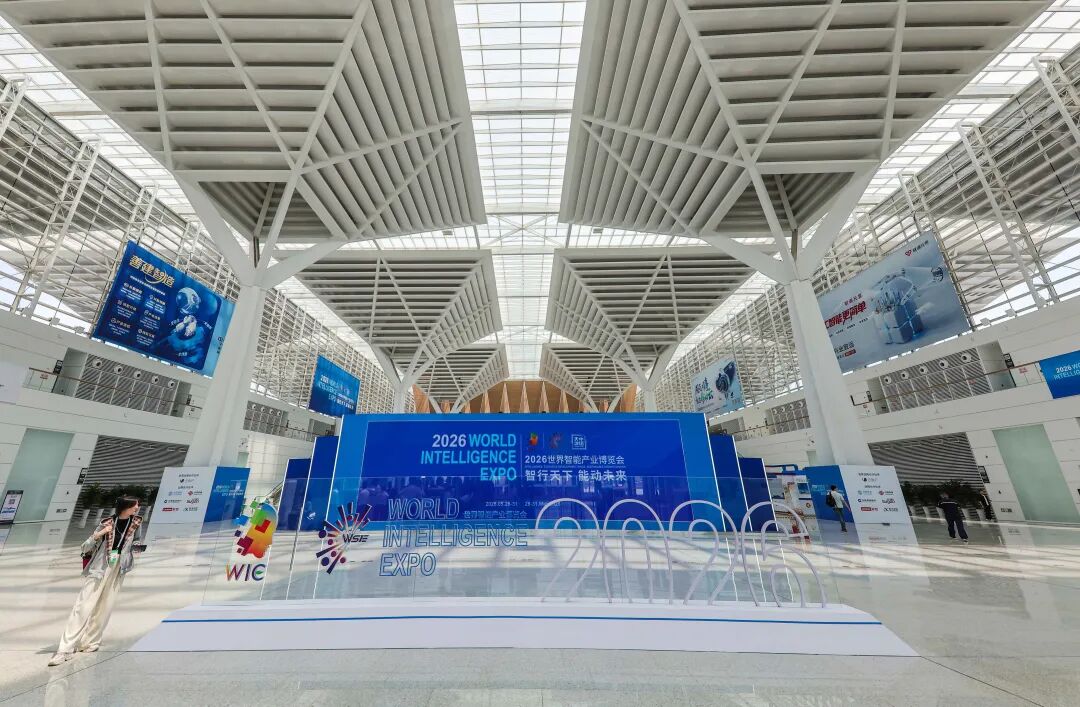
World Intelligence Expo 2026 kicks off today. Photo by Wu Di
Tianjin Municipal People's Government has signed separate strategic cooperation agreements with China United Network Communications Group Co., Ltd. (China Unicom), China Mobile Communications Group Co., Ltd. (China Mobile), China Automotive Technology and Research Center Co., Ltd. (CATARC), and China Certification & Inspection Group Co., Ltd. (CCIC).
Pursuant to the strategic cooperation agreements Tianjin Municipal People's Government signed with the first two, the parties will leverage "connectivity + computing power + capabilities" as the core driving force to jointly advance the development of Tianjin's digital economy and inject new momentum into smart city upgrading.
As central SOEs in the network information service sector, as well as leading domestic digital information service providers and telecom operators, China Unicom and China Mobile have, in recent years, been advancing urban digital and intelligent transformation by building robust network foundations, leveraging computing power, and driving application innovation, and are fully supporting the development of Tianjin's digitalization and smart city initiatives.
Under the agreement, Tianjin and China Unicom will jointly develop new infrastructure and intelligent computing bases, focus on fostering multi-dimensional AI application scenarios across industries, expand data circulation scenarios, fully enable the digital and intelligent transformation of industries, deepen collaboration on digital government development, and promote digital and intelligent upgrades in science, education, medical, and health sectors. Meanwhile, the two parties will systematically strengthen the city's digital security defenses and build a new government-enterprise collaborative ecosystem for the development of a digital Tianjin.
To date, China Unicom has built over 29,000 5G (Fifth Generation of Cellular Network Technology) base stations in Tianjin, achieving full coverage of the city's urban and rural areas, transportation arteries, and key industrial parks. It has developed a premium triple-gigabit network featuring "gigabit 5G + gigabit broadband + gigabit WiFi (Wireless network)", and invested nearly RMB 5 billion in Wuqing District to construct the China Unicom Beijing-Tianjin-Hebei Digital Technology Industrial Park. Leveraging its computing power advantages, as well as cutting-edge technologies, products, and industry-specific solutions in such areas as "AI + industrial development", "AI + people's well-being", "AI + governance capacity", and "AI + consumption quality upgrade", China Unicom has been actively enabling transformation in fields including government services, smart transportation, and smart healthcare in Tianjin, and driving continuous improvements in urban governance efficacy.
China Mobile has also been consistently supporting the development of a digital Tianjin and the building of a smart city. At the Second Container Terminal of Tianjin Port, China Mobile's next-generation information technologies, including "5G + Beidou high-precision positioning + AI", have been improving quality and empowering the development of a smart port. By strengthening, refining, and expanding its communication, computing, and intelligent services, China Mobile has been fully advancing the in-depth integration of Tianjin's real economy and digital economy.
In recent years, China Mobile has deployed 32,000 5G base stations in Tianjin, achieving full coverage of 5G-A (5G-Advanced) AI-integrated networks in the main urban areas of Tianjin; 10G fiber optic networks now cover 321 10G-enabled residential compounds and 223 10G-enabled blocks; the company has connected to the national data infrastructure's full-domain functional nodes; and built over 200 5G demonstration projects. During the 15th Five-Year Plan period, China Mobile will conduct all-around, in-depth strategic cooperation with Tianjin in the following areas: Co-building new information infrastructures and a sci-tech innovation ecosystem, advancing the digital economy and industrial digital transformation, upgrading people's livelihood services and consumption quality, and developing a digital government and modern urban governance, so that digital dividends can better fuel the city's high-quality development.
As a national pillar of the automotive industry, CATARC will engage in strategic cooperation with Tianjin, focusing on the high-quality development of the automotive industry. The two parties will collaborate in fields including intelligent connected vehicles (ICVs), new energy, testing and certification, trusted data spaces, and industrial platforms to strengthen sci-tech innovation synergy.
An Tiecheng, Chairman of CATARC, stated that CATARC has developed its business with Tianjin as its base and achieved fruitful results. The company has designated Tianjin as the core hub for its ICV business. It has registered and established CATARC Intelligent Technology (Tianjin) Co., Ltd. in Tianjin, with a view to building a cluster of advanced laboratories covering intelligent driving, cybersecurity, AI, and the low-altitude economy. This initiative will achieve full coverage of ICV R&D and testing capabilities, and develop Tianjin into a national cluster for ICV innovation and development.
Meanwhile, CATARC will increase investment in its New Energy Vehicle (NEV) Inspection Center. The Phase II project will focus on upgrading four core platforms to precisely meet industry demands, fill domestic technological gaps, and collaborate with Tianjin to develop an NEV Industry Innovation Port, thereby growing the city into a major NEV R&D and manufacturing hub in northern China.
In addition, CATARC will establish specialized R&D centers to concentrate on key generic technologies for the automotive industry, accelerate breakthroughs in core technologies, drive industrial technological transformation, and develop Tianjin into a national source of generic technologies for the automotive sector.
The strategic cooperation agreement signed between Tianjin and CCIC will cover multiple areas, including industrial upgrading, port development, green and low-carbon initiatives, urban safety, and talent development, to support Tianjin in building a highland for inspection and testing services.
"As a Chinese central SOE delivering full-spectrum services, a domestic pioneer and global top-10 player, CCIC has operated in Tianjin for over 30 years. Since entering the Tianjin market in 1992, it has established 10 wholly-owned and controlled enterprises, with its business spanning key sectors such as autos, petrochemicals, new energy, life and health, as well as energy conservation and environmental protection," said Wan Xinming, Member of the Party Committee and Deputy General Manager of CCIC.
Wan noted that this cooperation will focus on six key priorities: Focus on industrial agglomeration, integrate government and enterprise resources, co-develop specialized inspection and testing parks, and build a full-chain industrial ecosystem; enhance port capacity, increase investment in inspection infrastructure at Tianjin Port, and support bulk commodity trade and the automobile import and export industry; deepen engagement in the green and low-carbon sector, support Tianjin's development as a carbon peaking pilot city, and refine the carbon accounting system for key domains; concentrate on people's well-being and urban safety, roll out the "NQI (National Quality Infrastructure) + Beidou" urban safety project, and participate in livelihood projects, including the renovation of aging facilities and testing of new energy equipment; center on key industry chains to strengthen technical services for metrology and testing and support competitive industries in reinforcing, supplementing, and extending their chains. Furthermore, the two parties will deepen school-local government collaboration, jointly cultivate high-caliber talent in the inspection and testing field, and consolidate the talent foundation for the industry.

World Intelligence Expo 2026 kicks off today. Photo by Wu Di
Tianjin Municipal People's Government has signed separate strategic cooperation agreements with China United Network Communications Group Co., Ltd. (China Unicom), China Mobile Communications Group Co., Ltd. (China Mobile), China Automotive Technology and Research Center Co., Ltd. (CATARC), and China Certification & Inspection Group Co., Ltd. (CCIC).
Pursuant to the strategic cooperation agreements Tianjin Municipal People's Government signed with the first two, the parties will leverage "connectivity + computing power + capabilities" as the core driving force to jointly advance the development of Tianjin's digital economy and inject new momentum into smart city upgrading.
As central SOEs in the network information service sector, as well as leading domestic digital information service providers and telecom operators, China Unicom and China Mobile have, in recent years, been advancing urban digital and intelligent transformation by building robust network foundations, leveraging computing power, and driving application innovation, and are fully supporting the development of Tianjin's digitalization and smart city initiatives.
Under the agreement, Tianjin and China Unicom will jointly develop new infrastructure and intelligent computing bases, focus on fostering multi-dimensional AI application scenarios across industries, expand data circulation scenarios, fully enable the digital and intelligent transformation of industries, deepen collaboration on digital government development, and promote digital and intelligent upgrades in science, education, medical, and health sectors. Meanwhile, the two parties will systematically strengthen the city's digital security defenses and build a new government-enterprise collaborative ecosystem for the development of a digital Tianjin.
To date, China Unicom has built over 29,000 5G (Fifth Generation of Cellular Network Technology) base stations in Tianjin, achieving full coverage of the city's urban and rural areas, transportation arteries, and key industrial parks. It has developed a premium triple-gigabit network featuring "gigabit 5G + gigabit broadband + gigabit WiFi (Wireless network)", and invested nearly RMB 5 billion in Wuqing District to construct the China Unicom Beijing-Tianjin-Hebei Digital Technology Industrial Park. Leveraging its computing power advantages, as well as cutting-edge technologies, products, and industry-specific solutions in such areas as "AI + industrial development", "AI + people's well-being", "AI + governance capacity", and "AI + consumption quality upgrade", China Unicom has been actively enabling transformation in fields including government services, smart transportation, and smart healthcare in Tianjin, and driving continuous improvements in urban governance efficacy.
China Mobile has also been consistently supporting the development of a digital Tianjin and the building of a smart city. At the Second Container Terminal of Tianjin Port, China Mobile's next-generation information technologies, including "5G + Beidou high-precision positioning + AI", have been improving quality and empowering the development of a smart port. By strengthening, refining, and expanding its communication, computing, and intelligent services, China Mobile has been fully advancing the in-depth integration of Tianjin's real economy and digital economy.
In recent years, China Mobile has deployed 32,000 5G base stations in Tianjin, achieving full coverage of 5G-A (5G-Advanced) AI-integrated networks in the main urban areas of Tianjin; 10G fiber optic networks now cover 321 10G-enabled residential compounds and 223 10G-enabled blocks; the company has connected to the national data infrastructure's full-domain functional nodes; and built over 200 5G demonstration projects. During the 15th Five-Year Plan period, China Mobile will conduct all-around, in-depth strategic cooperation with Tianjin in the following areas: Co-building new information infrastructures and a sci-tech innovation ecosystem, advancing the digital economy and industrial digital transformation, upgrading people's livelihood services and consumption quality, and developing a digital government and modern urban governance, so that digital dividends can better fuel the city's high-quality development.
As a national pillar of the automotive industry, CATARC will engage in strategic cooperation with Tianjin, focusing on the high-quality development of the automotive industry. The two parties will collaborate in fields including intelligent connected vehicles (ICVs), new energy, testing and certification, trusted data spaces, and industrial platforms to strengthen sci-tech innovation synergy.
An Tiecheng, Chairman of CATARC, stated that CATARC has developed its business with Tianjin as its base and achieved fruitful results. The company has designated Tianjin as the core hub for its ICV business. It has registered and established CATARC Intelligent Technology (Tianjin) Co., Ltd. in Tianjin, with a view to building a cluster of advanced laboratories covering intelligent driving, cybersecurity, AI, and the low-altitude economy. This initiative will achieve full coverage of ICV R&D and testing capabilities, and develop Tianjin into a national cluster for ICV innovation and development.
Meanwhile, CATARC will increase investment in its New Energy Vehicle (NEV) Inspection Center. The Phase II project will focus on upgrading four core platforms to precisely meet industry demands, fill domestic technological gaps, and collaborate with Tianjin to develop an NEV Industry Innovation Port, thereby growing the city into a major NEV R&D and manufacturing hub in northern China.
In addition, CATARC will establish specialized R&D centers to concentrate on key generic technologies for the automotive industry, accelerate breakthroughs in core technologies, drive industrial technological transformation, and develop Tianjin into a national source of generic technologies for the automotive sector.
The strategic cooperation agreement signed between Tianjin and CCIC will cover multiple areas, including industrial upgrading, port development, green and low-carbon initiatives, urban safety, and talent development, to support Tianjin in building a highland for inspection and testing services.
"As a Chinese central SOE delivering full-spectrum services, a domestic pioneer and global top-10 player, CCIC has operated in Tianjin for over 30 years. Since entering the Tianjin market in 1992, it has established 10 wholly-owned and controlled enterprises, with its business spanning key sectors such as autos, petrochemicals, new energy, life and health, as well as energy conservation and environmental protection," said Wan Xinming, Member of the Party Committee and Deputy General Manager of CCIC.
Wan noted that this cooperation will focus on six key priorities: Focus on industrial agglomeration, integrate government and enterprise resources, co-develop specialized inspection and testing parks, and build a full-chain industrial ecosystem; enhance port capacity, increase investment in inspection infrastructure at Tianjin Port, and support bulk commodity trade and the automobile import and export industry; deepen engagement in the green and low-carbon sector, support Tianjin's development as a carbon peaking pilot city, and refine the carbon accounting system for key domains; concentrate on people's well-being and urban safety, roll out the "NQI (National Quality Infrastructure) + Beidou" urban safety project, and participate in livelihood projects, including the renovation of aging facilities and testing of new energy equipment; center on key industry chains to strengthen technical services for metrology and testing and support competitive industries in reinforcing, supplementing, and extending their chains. Furthermore, the two parties will deepen school-local government collaboration, jointly cultivate high-caliber talent in the inspection and testing field, and consolidate the talent foundation for the industry.
 WeChat Official Account
 Official WeChat Channel
 Official Mini Program
 Official Douyin Account
 Email
Email
 Official Website
 400 Hotline
 Inquiry Hotline
 Tianjin Public Network Security Filing No. 12010302002098 Official Statement
WeChat Official Account
Official WeChat Channel
Official Mini Program
Official Douyin Account
Email
Official Website
400 Hotline
Inquiry Hotline
Tianjin Public Network Security Filing No. 12010302002098 Official Statement
Tianjin Public Network Security Filing No. 12010302002098 Official Statement
WeChat Official Account
Official WeChat Channel
Official Mini Program
Official Douyin Account
Email
Official Website
400 Hotline
Inquiry Hotline
Tianjin Public Network Security Filing No. 12010302002098 Official Statement

